


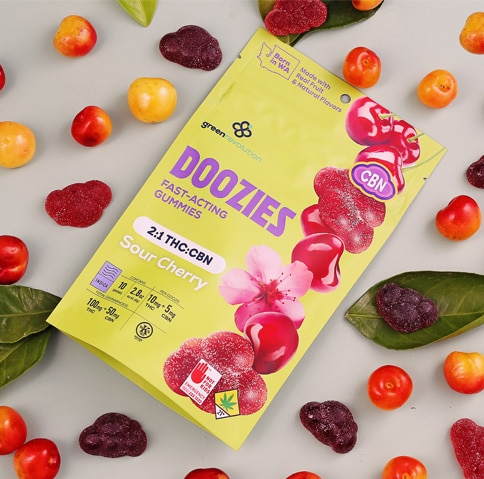
Small Is Powerful: How Nano Technology Is Transforming Today’s Cannabis Edibles
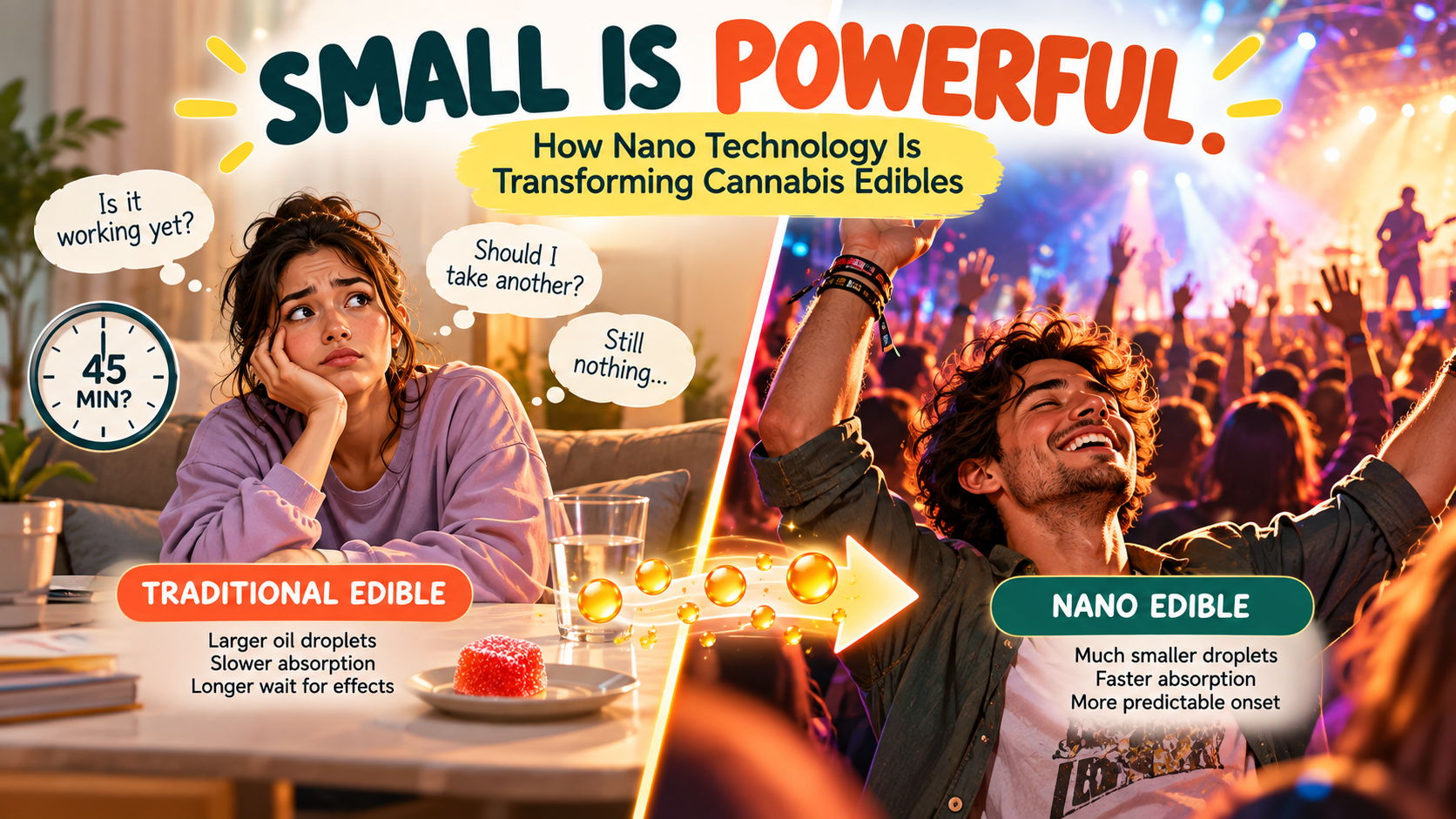
You take an edible. You wait 45 minutes. Nothing. You start wondering, “Is this working yet?” Maybe you take another one. Then, suddenly, both show up to the party. For today’s savvy cannabis consumer, this situation is far too familiar.
The question isn’t simply how much THC? It’s how precisely can I control the experience? A 2:1 CBD-to-THC gummy for a relaxed afternoon. A balanced THC/CBD beverage for a concert. A low-dose THC edible when you want to enhance the evening without taking yourself out of it. Cannabis has become less about getting “high” and more about dialing in an experience.
That’s where nanoemulsification enters the picture.
Cannabinoids such as THC and CBD are highly fat-soluble and don’t naturally mix well with water. In a conventional edible, that can create a significant absorption challenge. Some of the cannabinoids may pass through the digestive system without being absorbed efficiently, while another portion is metabolized by the liver before reaching systemic circulation. Research has estimated oral THC bioavailability at roughly 6–10% in some formulations, although results vary considerably depending on the product and individual.
Nanoemulsification tackles the problem at the microscopic level. Instead of dispersing relatively large droplets of cannabis oil through a gummy, drink or other edible, the cannabinoids are broken into extremely small droplets and stabilized within an emulsion. Smaller droplets create dramatically more surface area, allowing the cannabinoids to interact more efficiently with the aqueous environment of the gastrointestinal tract and making them easier for the body to absorb.
Why nano acts faster. Nano puts predictability in your edible.
Traditional edibles can be notoriously slow and unpredictable. Depending on the formulation, food intake and individual metabolism, effects may take well over an hour to become noticeable, with peak blood concentrations often occurring several hours after consumption. A systematic review of 26 human studies found substantial variability in the absorption of orally consumed THC across different formulations.
Nano-formulations are designed to shorten that waiting game.
In a recent controlled crossover study of 14 healthy adults, a self-nanoemulsifying THC/CBD formulation produced substantially higher peak blood concentrations than an equivalent oil-based formulation. The study found more than double the relative cannabinoid bioavailability, while the time to peak concentration for key metabolites was considerably shorter.
Another human study of a pro-nano cannabinoid formulation found approximately 1.6× higher peak plasma concentrations for THC and CBD and significantly faster absorption, with median time to peak concentration falling from 3.5 hours to 1.3 hours.
That difference matters when an edible is meant to fit into real life.
A nano-infused beverage can begin to feel more responsive to the moment. A gummy can be designed to deliver a more predictable experience without requiring a large amount of cannabis oil. Consuming a fast-acting, nano-infused edible puts you completely in control of your own experience. The edible kicks in like clockwork, when you expect it, and enhances the moment instead of arriving too late to make a difference.
And because more of the active compounds may become available for absorption, formulators can potentially achieve a desired effect with a smaller amount of cannabinoid material—although the appropriate dose still depends on the individual and the specific formulation.
Edibles with benefits: making more of what you take
Think of conventional cannabis oil as a crowd trying to get through a narrow doorway. Nanoemulsification essentially changes the size and behavior of the crowd, giving more of the cannabinoids an opportunity to cross the absorption barrier.
That doesn’t mean every molecule gets absorbed—no oral delivery system achieves 100% bioavailability. It means the formulation can reduce one of the fundamental obstacles of oral cannabis: getting poorly water-soluble cannabinoids into a form the gastrointestinal system can more readily process and absorb.
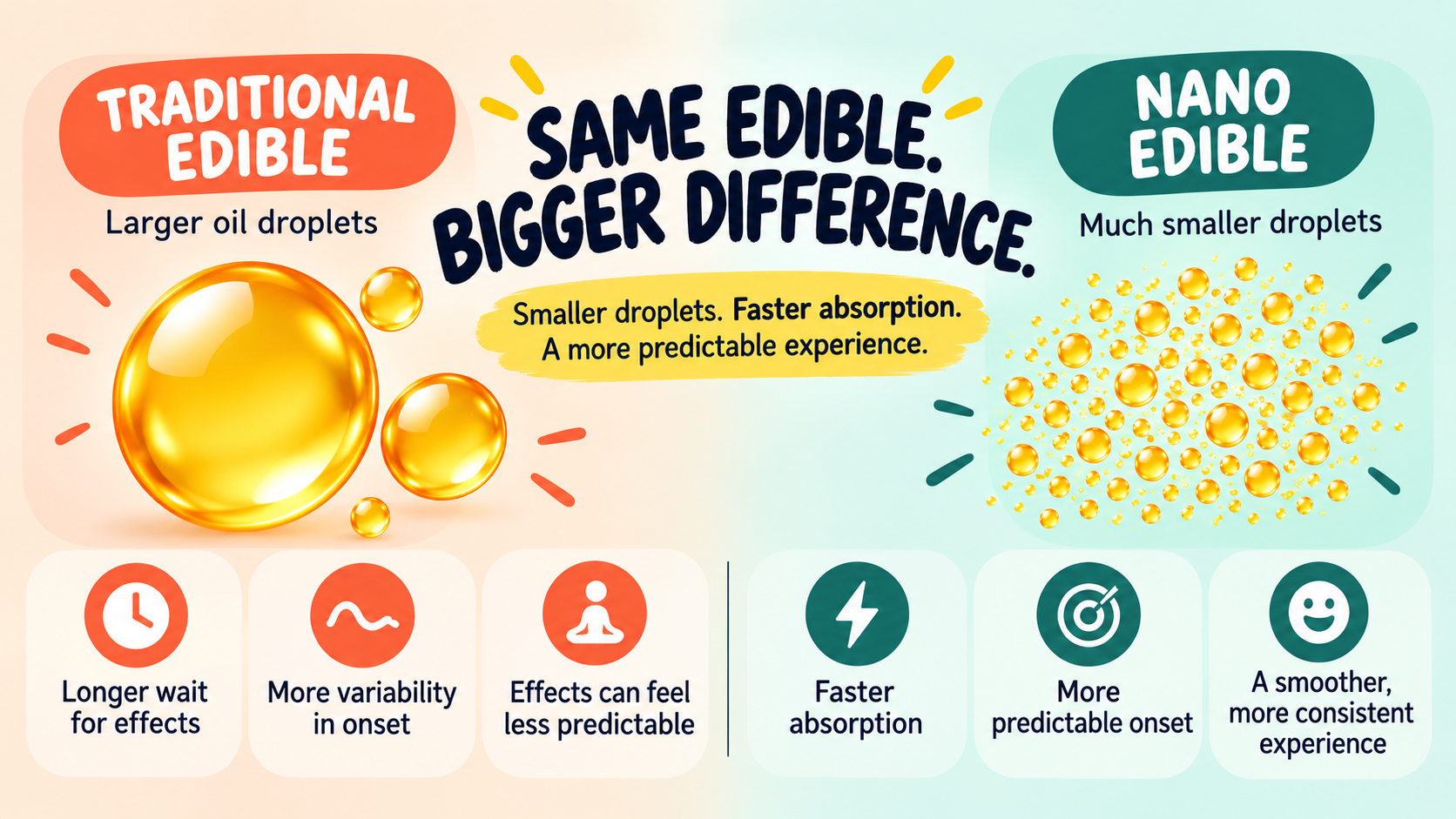
And that distinction is important. Better absorption isn’t necessarily about making an edible stronger. It can be about making it more efficient and predictable.
For sophisticated consumers who already think in ratios, milligrams and timing, that’s a meaningful evolution. Instead of simply choosing between “high THC” and “low THC,” consumers can increasingly select formulations based on the relationship between THC, CBD and other cannabinoids—and how quickly and consistently they want those compounds delivered.
Precision edibles for a refined experience
Nanoemulsification is part of a larger shift in cannabis culture: from crude dosing to precision consumption.
The modern edible isn’t necessarily designed to knock you off your feet. It might be a 2.5 mg THC gummy before dinner, a CBD-forward formulation during the day, or a precisely balanced THC/CBD beverage to enhance your concert-going experience. The objective is control—finding a repeatable dose that complements the experience rather than overwhelming it.
Nano technology doesn’t change what THC or CBD are. It changes how efficiently the body can encounter them.
And in a category increasingly defined by personalization, that’s a pretty big difference for something measured in nanometers.
Today’s cannabis has evolved from simply asking “How strong is it?” toward “What experience do I want, and when do I want it?”
“Look for ‘nano’ or ‘fast-acting’ on the label, start low, and give it 20–30 minutes before taking more.”
** sources for sited data include: the Journal of Cannabis Research human crossover study, PubMed’s review of oral cannabinoid delivery, and the British Journal of Clinical Pharmacology review.

